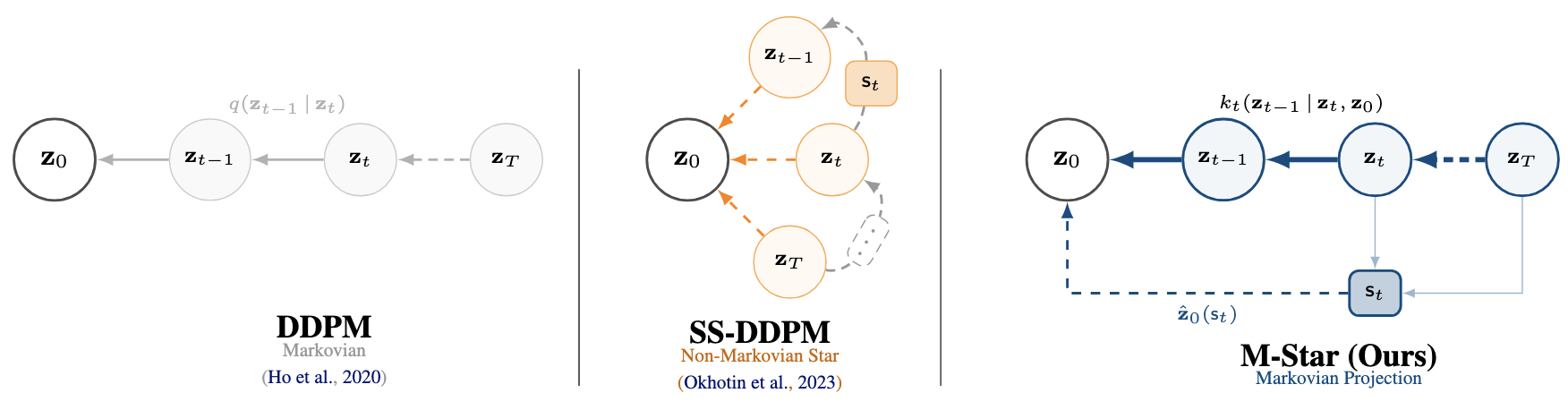
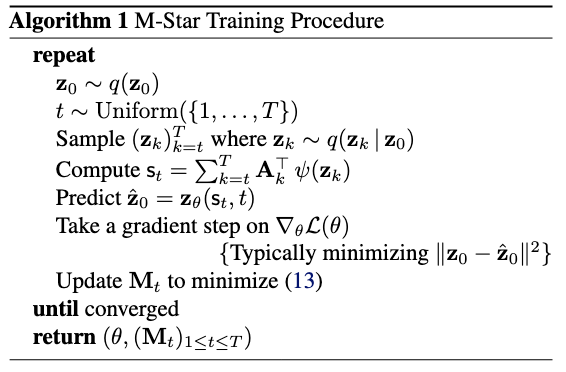
Training Process: The M-Star training procedure learns to predict clean data z₀ from the sufficient tail statistic st while simultaneously optimizing the interaction matrix Mt. At each iteration, the algorithm samples a random timestep and generates noisy states from the star-shaped forward process. The tail statistic st = Σk=tT Ak⊤ψ(zk) compresses the entire future trajectory into a fixed-size representation, enabling efficient learning across all timesteps. The learnable interaction matrix Mt balances local coherence from the current state with global guidance from the predicted clean data, minimizing prediction error through KL divergence optimization.
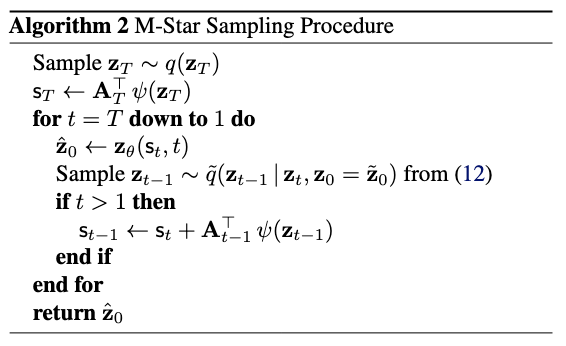
Sampling Process: The M-Star sampling procedure generates high-quality samples through iterative denoising from pure noise. Starting from zT ~ q(zT), the algorithm iteratively predicts the clean data ẑ₀ from the current tail statistic and samples the next state from the Markovian reverse distribution q̃(zt-1 | zt, z₀ = ẑ₀). The tail statistic is efficiently updated at each step by incorporating the sufficient statistic of the newly sampled state. This Markovian structure ensures temporal coherence between consecutive states, preventing the erratic trajectories that can occur in non-Markovian approaches.
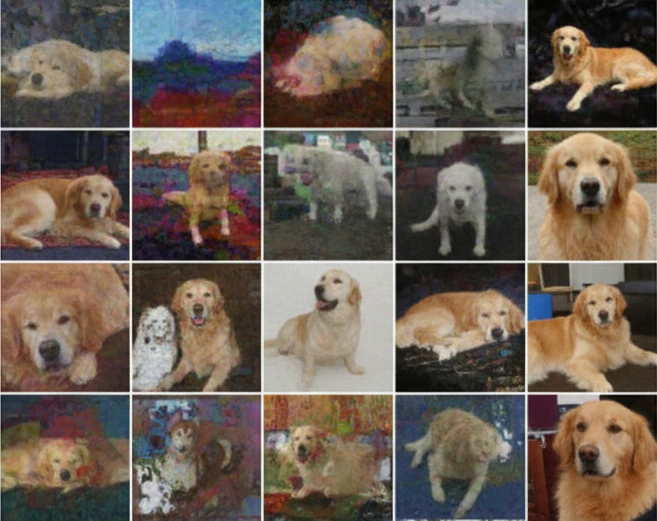
M-Star generates high-quality images unconditionally. The Markovian projection maintains temporal coherence throughout the sampling process, resulting in superior sample quality compared to SS-DDPM. By learning to predict clean data from any timestep, M-Star is particularly well-suited for progressive distillation, enabling few-step or even single-step generation without sacrificing quality. The framework generalizes standard DDPMs to exponential family distributions while preserving the benefits of sequential generation, making it applicable to diverse data modalities including directional data, constrained geometries, and meteorological datasets.